Mutualism is a relationship between two species in which both organisms benefit. Bees and flowers is an example; bees get food and flowers reproduce. Another example is clownfish; clownfish get protected from their predators, and anemone get protection from their's.
Parasitism is a relationship in which only one animal benefits. An example of this is humans and headlice; headlice get a place to live, and humans get an itchy scalp. Another example is some birds laying their eggs in other bird's nests.
In commenalism, both organisms receive neither benefits nor harms. An example of this is an orchid growing on a tree, where neither of them are interfering with each other's energy gathering.
Tuesday, August 25, 2015

Organic Compounds
- carbohydrates- quick energy storage
- lipids-long term energy storage, make up cell membranes.
- proteins- speed up chemical reactions (enzymes).
- nucleic acids- nucleic acids make up DNA and RNA.
Lipids are made of glycerol and fatty acids.
Proteins are made of amino acids.
Nucleic acids are made of nucleotides.
Monday, August 24, 2015
Why Evolution is Real
- Fossil Records- fossils from various dates show the process of certain features changing over millennia as one species turns into another (or some population of a species).
- Embryology- The embryos of many vastly different species look similar. This shows genetic similarity that goes way back.
- Structural Similarities- Many animals have similar skeletons; whales, humans, and dogs all have fingerbones that are structurally similar, but different in length and use. While all birds have beaks, they also have structures that show that they have adaptations to their unique environment.
Some Other Methods of Evolution
Genetic drift- this is random fluctuations in the genetic material of a population.
Mutation- chance errors in genetic code occur over generations, eventually altering life, if they are allowed to snowball.
Gene flow is the transfer of alleles to separate populations. Certain individuals of a population of animals with a common characteristic mix in with a new population and change that population's characteristics.
Recombination- The crossing over of genes can result in children with different characteristics than their parents. If this is an advantageous feature, it is likely to get passed down.
Mutation- chance errors in genetic code occur over generations, eventually altering life, if they are allowed to snowball.
Gene flow is the transfer of alleles to separate populations. Certain individuals of a population of animals with a common characteristic mix in with a new population and change that population's characteristics.
Recombination- The crossing over of genes can result in children with different characteristics than their parents. If this is an advantageous feature, it is likely to get passed down.
Darwin v Lamarck
Darwin believed that evolution worked through natural selection. If an individual has a characteristic that allows it to survive, then that characteristic will be passed to its children. If other individuals without this characteristic die, only the survivors with the characteristic will pass their genes down. This difference is small in the long run, but leads to big changes over millions of years. An example of this is giraffes with longer necks being able to get more food and survive, which means, as more and more short neck giraffes don't live to reproduce, the population of giraffes get longer necks. Another example of this is the birds Darwin found on the Galapagos having beaks suited to the food on certain islands.
Lamarck believed that certain characteristics will become more pronounced in a population if they're used more often. An example of this would be a population of giraffes stretching their necks out so much that their offspring have longer necks, which is preposterous.
Lamarck believed that certain characteristics will become more pronounced in a population if they're used more often. An example of this would be a population of giraffes stretching their necks out so much that their offspring have longer necks, which is preposterous.
Xylem and Phloem
Xylem and phloem both act as pathways in the plant, like a cardiovascular system. However, xylem goes up, while phloem goes down. They both transport and store nutrients. However, while xylem transports water primarily, phloem transports and stores organic compounds.
Bryophytes, ferns, gymnosperms, angiosperms
Bryophytes are nonvascular plants. These include mosses and liverworts.
Ferns do not have seeds. Instead, they reproduce via spores.
Angiosperms are plants that produce flowers. Angiosperms also give fruit.
Gymnosperms include conifers and ginkgo. They produce seeds, but they do not make fruit.
Ferns do not have seeds. Instead, they reproduce via spores.
Angiosperms are plants that produce flowers. Angiosperms also give fruit.
Gymnosperms include conifers and ginkgo. They produce seeds, but they do not make fruit.
The Body
- Circulatory- This system includes the heart and veins. It delivers oxygen that the respiratory system provides, in addition to other substances.
- Digestive- This system includes the stomach, small intestine, large intestine, mouth, and liver. It provides nutrition to the body, so all the other systems benefit.
- Nervous- The nervous system includes the brain, brainstem, spinal cord, and nerves. It interacts with the circulatory and digestive system by involuntarily keeping them active.
- Endocrine- The endocrine system is a way of providing hormones that regulate various systems. It releases, for example, adrenaline, which helps the circulatory system work harder as part of the fight or flight response.
- Reproductive- This system consists of the testes and penis or the ovaries and vagina. It interacts with the circulatory system in males because blood is used to cause erections.
- Respiratory- The respiratory system consists of the lungs, and it interacts with the circulatory system by providing the oxygen that the blood delivers.
- Excretory (including the urinary)- This system contains the kidneys, large intestine, liver, skin, ureters, bladder, and urethra. It interacts with the digestive system, getting rid of waste products that result from digestion.
- Immune system- The immune system consists primarily of the thymus and bone marrow. It protects the body from diseases. It interacts with the cardiovascular system
Sunday, August 23, 2015
The Three Domains
Archaea is full of microscopic organisms that can survive in the harshest of conditions.
Bacteria consists of microscopic life that can either harm us or help us.
Eukaryota are either uni- or multi- cellular organisms which are generally the most complex.
Kingdoms:
Archaea
Bacteria consists of microscopic life that can either harm us or help us.
Eukaryota are either uni- or multi- cellular organisms which are generally the most complex.
Kingdoms:
Archaea
- Thermophiles are organisms that survive in extremely hot environments.
- Halophiles can survive in extremely salty environments.
- Cyanobacteria- These bacteria obtain energy through photosynthesis.
- Heterotrophic bacteria- The typical bacterium obtains energy from its environment.
- Fungae- They are similar to plants, however, they are heterotrophic and their cell walls contain chintin.
- Animalia- This kingdom contains complex, multicellular organisms that do not use chlorophyl.
- Plante- These multicellular organisms generally use photosynthesis for energy and stay rooted in one spot.
- Protista- These are (typically) unicellular eukaryotes. Some live in colonies, like bacteria. They are typically
Incomplete Dominance
Incomplete dominance is when one allele for a certain trait doesn't totally override the recessive allele. This results in "hybrid" features. An example of this is pink snapdragon plants. These plants are created by cross-polinating red and white snapdragons.
Laws of Dominance and Segregation
The law of dominance was proposed by Gregor Mendel. It states that there will always be alleles in pairs of dominant and recessive, unless both are recessive.
The law of segregation, also proposed by Mendel, says that allele pairs separate during gamete formation, and randomly unite at fertilization..
The law of segregation, also proposed by Mendel, says that allele pairs separate during gamete formation, and randomly unite at fertilization..
Saturday, August 22, 2015
Genotype v Phenotype
Genotypes are the information carried by genetic material. Phenotypes are the expression of genotypes. Genotypes contain all genetic information, even non-expressed info. Phenotypes only convey what is expressed.
They are both somewhat influenced by heredity.
They are both somewhat influenced by heredity.
Autosomes and Sex Chromosomes- Contrast and Compare
Autosomes are somatic chromosomes that control the body's characteristics. Sex chromosomes control the sex of the individual. Autosomes greatly outnumber sex chromosomes. Sex chromosomes are referred to as allosomes. They are similar in that they both come in pairs.
Explain how an allele is different from a gene and the relationship between the two
Genes are sections of DNA that control a certain trait, such as eye color. Alleles are specific variations, for example blue, brown, or green eyes. Depending on how a gene is expressed, many alleles can occur.
Transcription in prokaryotes and eukaryotes
In Prokaryotes:
- not paired with translation
- occurs in the nucleus
- RNA is processed in the nucleus
- Initiation requires proteins
- paired with translation
- occurs in the cytoplasm
- RNA is processed in the cytoplasm
- no proteins are required to begin transcription.
Translation
Translation is the rendering of something into another language or into one's own from another language.
Just kidding.
In biology, translation is the process by which mRNA and tRNA work together in the ribosome to make proteins.
Just kidding.
In biology, translation is the process by which mRNA and tRNA work together in the ribosome to make proteins.
- Initiation- The mRNA binds to a ribosome's subunit
- Elongation- A polypeptide chain is formed based on the mRNA and tRNA strands.
- Termination- When the stop codon is reached, a release factor frees the polypeptide and dissociates the ribosome.
Transcription
Transcription is the process in which DNA is used to create a complementary DNA copy called mRNA. There are 3 steps.
- RNA polymerase binds to DNA. RNA polymerase is an enzyme that binds to DNA. There are certain START and STOP DNA sequences that tell RNA polymerase where to bind and transcribe.
- Elongation. Transcription factors unwind DNA and allow RNA polymerase access to only a part of the DNA double helix. Guanine pairs with cytosine, and adenine pairs with uracil.
- Termination. When RNA polymerase reaches the termination sequence, RNA polymerase releases mRNA.
DNA Replication
In the first step of replication, the DNA double helix is split into two strands at the replication origins. This is done with DNA helicase, an enzyme. The DNA helicase creates a "replication fork". One strand is oriented '5 to 3' and the other 3' to 5'.
In the second step, RNA primase is used to have complementary nucleotides bond to the nucleotides on the original strand. An enzyme called DNA polymerase actually bonds and proofreads the new nucleotides, but RNA primase gets the original nucleotides ready, or "primed".
In the third step, the new strand must be sealed. DNA isn't just made of the two complementary nucleotides, after all. There is also a "backbone" made of phosphates and sugars. DNA ligase places this backbone on. The new DNA can now be used in a new cell once mitosis takes place.
In the second step, RNA primase is used to have complementary nucleotides bond to the nucleotides on the original strand. An enzyme called DNA polymerase actually bonds and proofreads the new nucleotides, but RNA primase gets the original nucleotides ready, or "primed".
In the third step, the new strand must be sealed. DNA isn't just made of the two complementary nucleotides, after all. There is also a "backbone" made of phosphates and sugars. DNA ligase places this backbone on. The new DNA can now be used in a new cell once mitosis takes place.
Friday, August 21, 2015
The Cell Cycle
- G1- Gap 1
- S- where DNA synthesis occurs
- G1- Gap 2
- M- Mitosis
- Interphase- the resting period
- Prophase- Chromatin starts to condense, spindle fibers start to form.
- Prometaphase- The nucleus's membrane disappears
- Metaphase- Spindle fibers align the chromosomes along the cell's middle.
- Anaphase- the chromosomes separate at their middles. The microtubules pull them to opposite ends of the cell.
- Telophase- The chromosomes and nucleotides disperse. The sister cells start forming.
- Cytokinesis- The cell splits in two. This is caused by a protein ring in animal cells and by the synthesis of a new cell wall in plant cells.
In mitosis, somatic cells split, and the genetic material stays the same, ideally. Meiosis, however, is the process by which sex cells split; the genetic material goes through processes that change its sequence. These processes are:
- Crossing over: chromosomes pair up and swap nucleotides
- Independent assortment: formation random combinations of chromosomes and randomly placed genes on certain homologous chromosomes.
- Fertilization: There are many different sperm cells that can bond with an egg, and they each have differently sequenced genes.
DNA vs RNA
DNA and RNA both carry genetic material and provide instructions for producing proteins. However, they do have key differences:
- DNA is a double helix, but RNA is a single strand
- DNA stores instructions permanently, but RNA delivers instructions to Ribosomes
- RNA is more resistant to UV radiation
- While DNA contains adenine, thymine, cytosine, and guanine, RNA contains adenine, uracil, cytosine, and guanine
- DNA stays in the nucleus (except for organelles that have their own genetic material), while RNA is found in a variety of places, including the nucleus, cytoplasm and ribosomes.
Wednesday, August 19, 2015
Oxidation vs Redox reactions
Oxidation: A chemical reaction in which an atom or ion loses electrons.
- Gain in valence.
- Reduction in valence.
Catabolic vs Anabolic reactions
Catabolic reactions break complex molecules into simpler ones by breaking up glucose. This releases energy that drives chemical reactions.
Anabolic reactions take simple molecules and turn them into complex ones. This uses up energy. Anabolic reactions are used to store energy or build up molecules.
Anabolic reactions take simple molecules and turn them into complex ones. This uses up energy. Anabolic reactions are used to store energy or build up molecules.
Sunday, August 16, 2015
Lyctic and Lysogenic Cycles
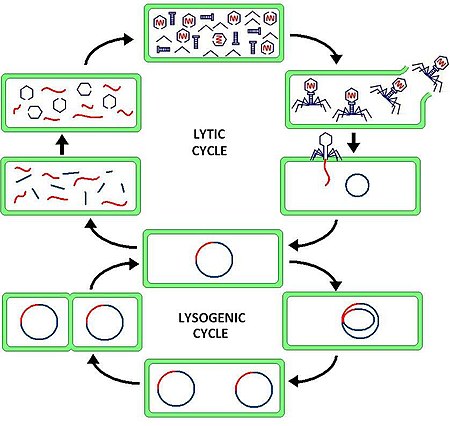
Viruses, Prions, and Viroids
Viruses
- Made up of proteins, nucleic acids, and sometimes lipids
- Can only reproduce by infecting a living host
- Don't use energy or make molecules
- Prions are forms of proteins that cause diseases
- Mad cow disease is caused by a prion
- They don't even have nucleic acids.
- Viroids are non-coding strands of RNA that infect plants.
The 7 Characteristics of Life
1. Living things are composed of cells
4. Living things are influenced by their environment
- Whether uni or multi cellular, there must be at least one cell in the equation for there to be life.
- Humans, for example, have organ systems made of organs made of tissues made of cells.
4. Living things are influenced by their environment
- For example, trees drop their leaves in response the the climate change that fall brings.
- Multi-cellular organisms grow as their cells multiply. Bacterial cells grow until they divide.
- For a species to survive, they must reproduce (looking at you, pandas). This can be asexual or sexual.
- Certain species of insects look like leaves or sticks in order to take advantage of living in an environment with lots of trees.
Why is transport essential to life?
There's a reason transport and important share quite a few letters. Without transport, a lot of essential cell processes would be impossible. Without transport, our cells would not be able to take in nutrients or water. They would also be unable to expel materials through vesicles (exocytosis). Homeostasis would be slowed to an almost halt, since cells would not be able to maintain their equilibrium. Overall, cellular transport is one of the worst things to give up for Lent.
Passive vs Active transport
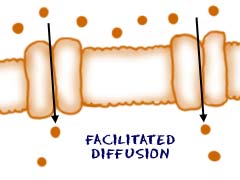
Passive transport moves molecules along a concentration gradient, while active transport moves molecules against a concentration gradient. Passive transport uses no ATP, while active transport does use ATP. An example of passive transport is the facilitated diffusion of a glucose molecule across the cell membrane by transport proteins. An example of active transport is a thyroid cell taking in iodine for use in hormone production.

Cellular Transport
There are four types of cellular transport: diffusion, osmosis, facilitated diffusion, and active transport.
- Diffusion is the process by which substances travel across a membrane from higher concentrations to lower concentrations. This process occurs until both sides are balanced, and it doesn't use ATP
- Osmosis is the diffusion of water.
- Facilitated diffusion- via special protein channels, molecules can cross a semipermeable or imperial membrane down the concentration gradient.
- Active transport moves from low to high on the concentration gradient and uses ATP.
- Ion pumps move ions across a plasma membrane from low to high on their concentration gradient. These pumps use ATP.
- In endocytosis, cells absorb proteins and other substances by surrounding them.
- In exocytosis, material is discharged by vesicles at a cell's surface.
Monday, August 10, 2015
Eukaryotic Cells vs. Prokaryotic Cells
Eukaryotic cells contain a nucleus and membrane-bound organelles. Some examples of eukaryotes are humans, cats, and trees. Protists, which are unicellular, are also eukaryotes.
Prokaryotic cells are simpler, containing no membrane-bound organelles. Some examples of prokaryotes are amoebae and bacteria.
- Their nucleus stores genetic information in the form of nucleic acids which determine heredity and direct a cell's activity.
- Mitochondria are double-membrane bound, and they power the cell through aerobic respiration.
- Eukaryotic cells contain a smooth endoplasmic reticulum (SER) and a rough endoplasmic reticulum (RER); The SER synthesizes lipids and the RER synthesizes proteins using ribosomes. The golgi apparatus transports substances produced the the SER and RER.
- Vesicles store substances, and lysosomes break down old substances.
Prokaryotic cells are simpler, containing no membrane-bound organelles. Some examples of prokaryotes are amoebae and bacteria.
- The genetic material floats semi-freely in the cytoplasm.
- The plasma membrane protects the inside of the cell from the outside world.
- Prokaryotic cells move using hairs called cillia or tail-like structures called flagella.
- Pili can be used to transport substances to other cells.
- Bacteria are surrounded by cell capsules, which are made of polysaccharides.
- Ribosomes produce proteins, like they do in Eukaryotic cells.
Subscribe to:
Comments (Atom)